
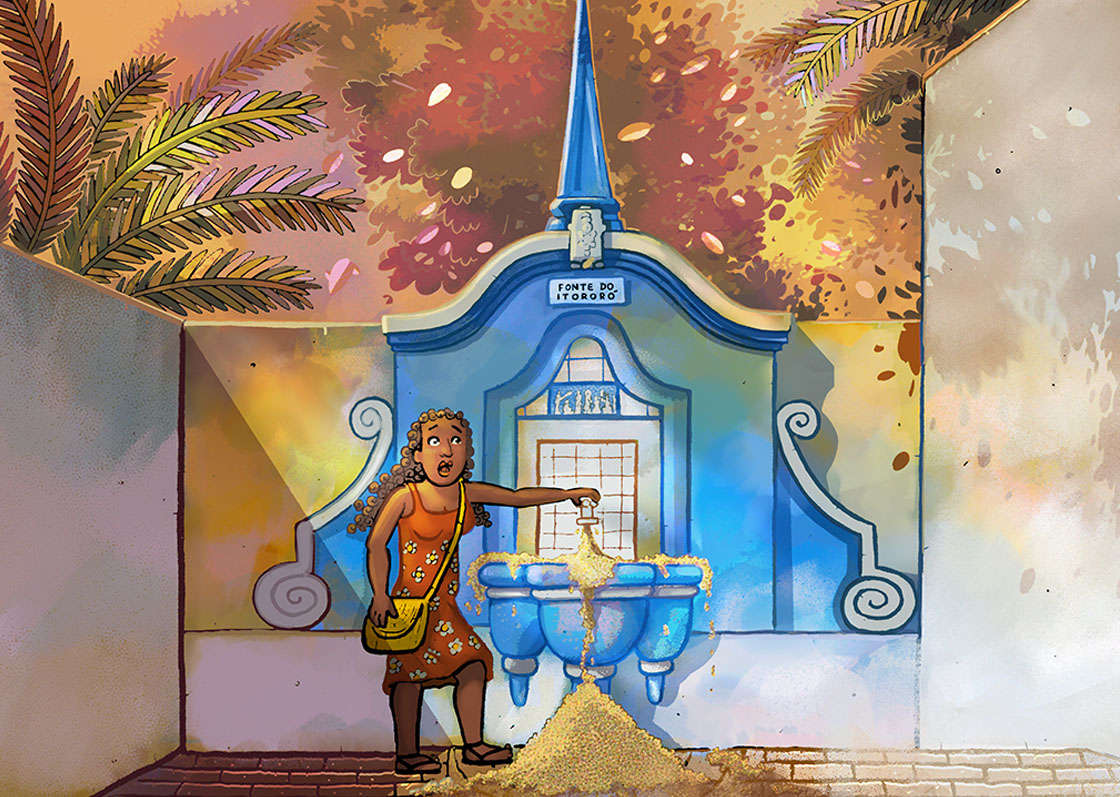
Illustration by Daniel Brás
Waters of Itororó
Folklore and history
I went to Itororó To drink water and didn't find any I found a beautiful brunette That I left in Itororó. Take advantage, my people For one night is nothing Whoever doesn't sleep now Will sleep at dawn
A song that keeps changing
There is no definitive record when it comes to songs. After all, they belong to the people, and they are always making their alterations to the verses. Depending on the rhythm, the place and even the one who sings the song, it is common for one theme to be linked to the next, giving shape to a very particular structure. That is, one song blends into another, so that it is difficult to distinguish what belongs to each song. It is easier to separate them into themes. Mário de Andrade reflects:
“Brazilian children's rounds present numerous processes of variation, deformation and transformation of musical and literary elements of Portuguese songs. Sometimes the mix is quite intricate. Texts and melodies are exchanged; several texts or several melodies are joined; the texts are fragmented and the melodies too” (Andrade, 1933, p. 94).
Villa-Lobos and the round dances
In the case of "Eu fui no Tororó", it is Heitor Villa-Lobos who constructs the arrangement in which the title theme is followed by the theme "Entrarás na roda ou ficars sozinha" (You will enter the circle or you will be alone). The maestro was a great enthusiast of popular cultures. Later, already integrated into the educational project of the Getúlio Vargas government, he would understand children as Brazilians in formation and value traditional culture as a way of building the values of the homeland.
In "Cirandas" (1926), Villa-Lobos revisits the children's repertoire, rewriting and arranging the melody of some songs, helping to fix them in time. Among the 16 songs, nursery rhymes and lullabies that make up the project, there is a version of "Fui no Tororó".
Where is Itororó?
It is assumed that the word actually comes from Tupi, "Y-Tororó", which means "spring of water". And where would this place be, therefore? Well, remembering its meaning in the indigenous language, we can understand that any place where there is gushing water is potentially the place of the song.
Still, there are some physical spaces in Brazil that are especially well-known. One of them is the Dique do Tororó, a water source in the city of Salvador. The lagoon is especially known for boasting eight statues of orixás produced by the sculptor Tatti Moreno: Oxalá, Iemanjá, Oxum, Ogum, Oxóssi, Xangô, Iansã and Nanã. The second place is the Itororó Fountain, in the city of Santos, SP.
This construction in Santos, SP, belonged to a Portuguese merchant named Brás Cubas, who used it to supply water to his tannery. Later, it served numerous other businesses, between the 19th and 20th centuries, always helping to quench the thirst of passersby. The chronicler Lydia Federici revived the memory of the fountain, now dry, in "A Fonte de Itororó", a text compiled in the book 36 mil dias de jornalismo (1994, p. 133–134). Another fountain of the same name is located in Guaratuba, PR, in the Largo de Nossa Senhora de Lourdes, and is considered miraculous. As with countless springs across the country, it is said that those who drink from its waters always return.

Waters of Itororó
Challenge / Toil
You went for a drink of water and found none. Ask the beautiful morena to help you quench your thirst.
Win · Send two Water cards from your hand or field to the Beleléu (your discard pile).

Download the high-resolution artwork

References
- ANDRADE, Mário de. Música, doce música. São Paulo: [L. G. Miranda], 1933. p. 94. Exemplar digitalizado pela Biblioteca Brasiliana Guita e José Mindlin, Universidade de São Paulo. (digital.bbm.usp.br)
- FEDERICI, Lydia. A Fonte de Itororó. In: BRUM, Eron. 36 mil dias de jornalismo: a história nas páginas de A Tribuna. 1. ed. Santos, SP: Editora A Tribuna, 1994. p. 133–134. Transcrição da digitalização.