
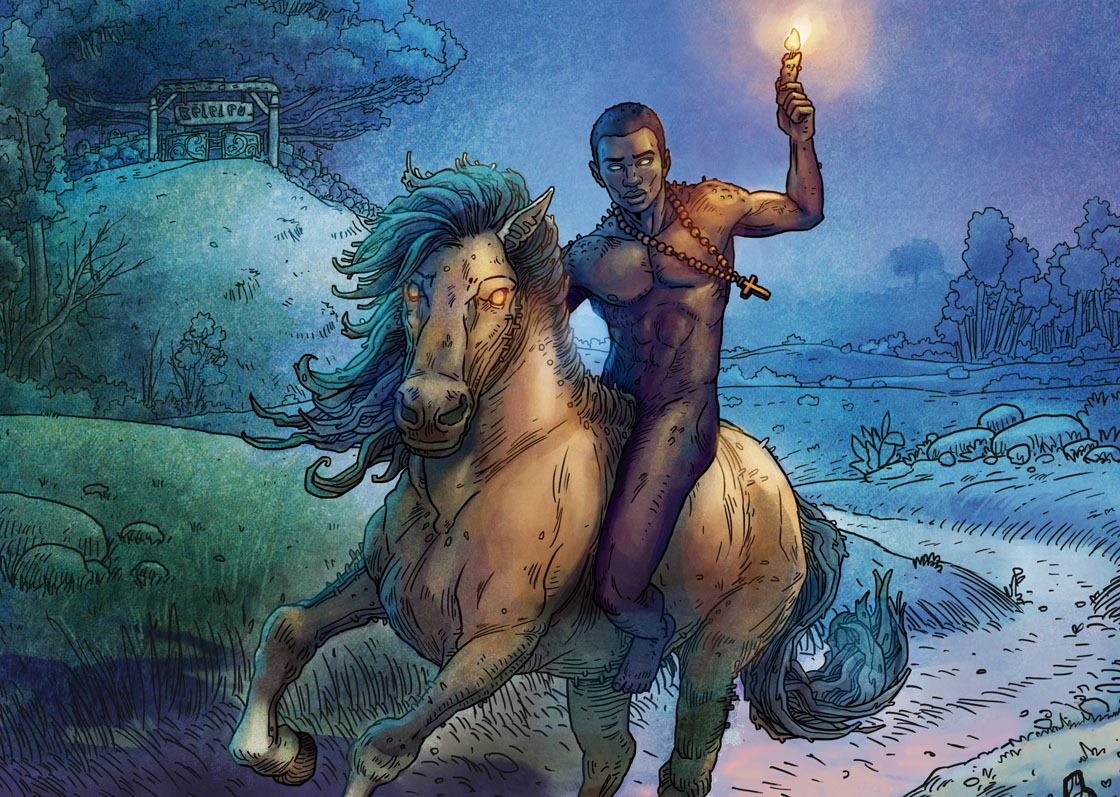
Illustration by Vitor Wiedergrun
Negrinho do Pastoreio
Folklore and history
Light candles, you who don't know the rest Of the old story that I cut in half And, at the foot of the candles, leave tobacco for Negrinho do Pastoreio – “Once upon a time”, by Aparício Rillo and Mário Barbará
From Violence to Devotion
Negrinho do Pastoreio is one of the most Christian-influenced figures in our popular culture. The narrative is from the pampas of Rio Grande do Sul and is usually set around the 19th century. It tells of a nameless black boy, who was either a young enslaved person or a child already freed by the Law of the Free Womb of 1871. Forced to herd the rancher's herd of horses for long nights – and boycotted by those who wished him harm – the boy is punished and brutally killed, at the whim of the landowner.
Blessed by Our Lady of Aparecida, however, Negrinho do Pastoreio returns from the dead. His task becomes to bring to others the hope and mercy that were denied him in life. In this mission, he is accompanied by a bay horse, that is, an animal with reddish-brown fur and black tips on its mane, tail, and legs, which was the rancher's favorite. Some say that, along with the boy and his bay horse, accompanies the sound of a herd of phantom horses that announce his passage.
The narrative is still quite present in Rio Grande do Sul, being especially alive in places like São Francisco de Paula, where there is a statue of Negrinho do Pastoreio made by Vasco Prado in the 1960s. Around it, the wax from the candles of the faithful has accumulated for decades – along with the requests made to the boy. They say that, for the apparition to help you, you need to offer a candle, a piece of tobacco, or say a prayer to it. People always turn to Negrinho do Pastoreio to find lost things.
There are written records, however, such as those of Walter Spalding, which speak of a technique to force Negrinho do Pastoreio of the Pasture to do what is desired: driving a stake into the ground, thus trapping him, and promising to release him only if he brings what was lost. It is an extreme measure, which the author emphasizes should only be used if the previous ones do not work.
Versions and records of the narrative
In “El negrito del pastoreo”, published in 1890, Javier Freyre situates the story in Paysandú, Uruguay. The version is reproduced and analyzed by Ellen dos Santos Oliveira (2021, pp. 243–246), based on Augusto Meyer. In it, the boy was herding sheep. As punishment, he is tied to stakes on an anthill, with his arms and legs spread out in a cross. He dies and comes to be worshipped as a martyr saint. His devotees ask him for protection against storms and epidemics in the flock.
It is curious to see how his presence in Gaucho culture was directly affected by traditionalist movements, causing many to be familiar with Negrinho do Pastoreio without necessarily having experienced his manifestation.
The most famous version of the legend known today is the story written in 1907 by João Simões Lopes Neto. This is an artistic creation of the author, inspired by a tradition that already existed, at least, since the last century. Although folklore and literature mutually affect each other, it is important to remember: literature fixes one version, while popular culture accepts several.
The first written record of Negrinho do Pastoreio, however, dates from more than half a century earlier. In 1857, the Portuguese consul António Maria do Amaral Ribeiro published, in Lisbon, “Lenda do Rio Grande”, in the Almanach de lembranças luso-brasileiro para 1858 (Oliveira, 2021, p. 83). The text, full of mockery, describes a moment when devotion to Negrinho was already established. The author laughs at the superstition of this “popular saint never seen before” – a criterion that, perhaps, he never applied to his own European saints. In any case, in his account, it is said that the custom was to light three candles to ask for the boy's favors: one for each type of cattle.
Several written records came later, until we arrived at Lopes Neto's version, which further reinforces its Christian indices. He, for example, establishes Our Lady as the godmother of Negrinho do Pastoreio and consolidates the version that the boy resurrected on the third day, after being left in the anthill.
Lopes Neto's version
In short, in the writer's version, Negrinho do Pastoreio worked for a very cruel rancher. One day, he lost a horse race in which the rancher had bet a lot of money. The rancher gave him a whipping and imposed a punishment: he would have to herd the herd of black horses for thirty days, without returning home. And more: the bay horse, the favorite, would not have a stake to graze on. Negrinho do Pastoreio was the one who would serve as a stake for him, holding the animal even while he slept.
The inevitable happened. While Negrinho do Pastoreio slept, the graxains (wild dogs) gnawed through the rope he was holding, and the bay horse ran away, taking all the others with it. Negrinho do Pastoreio prayed to his godmother, Our Lady of Aparecida, who helped him find the horses. However, the rancher's son, anxious to see the black boy fail, drove the horses away again and denounced him to his father.
This time, the punishment was greater. So great, that the boy could not endure the beating and fainted. To complete his cruelty, the rancher ordered that the body, still alive, be left in an anthill, so that the insects would not leave even the boy's bones.
From that night on, however, the man was haunted by nightmares. Night after night, he saw himself endlessly falling into the mouth of the same anthill. On the third day, he returned to the place to make sure that Negrinho do Pastoreio was really dead, but what he found was the opposite.
Right in front of him was Negrinho do Pastoreio, standing, with his skin intact. The boy shook the ants off his body and mounted the bay horse, having the blessings of Our Lady upon him. It was the farmer's turn to kneel before the one who had once served him.
As the poet Jayme Caetano Braun recalls, in a song in homage to Negrinho do Pastoreio, by placing the child's body in the anthill, the rancher plunged a spear deep into the very being of the countryside. A spear of shame. May the racist behavior of the farmer and his family in this story teach us to repudiate all reflections of this type of attitude, so frequent even today. (www.youtube.com)

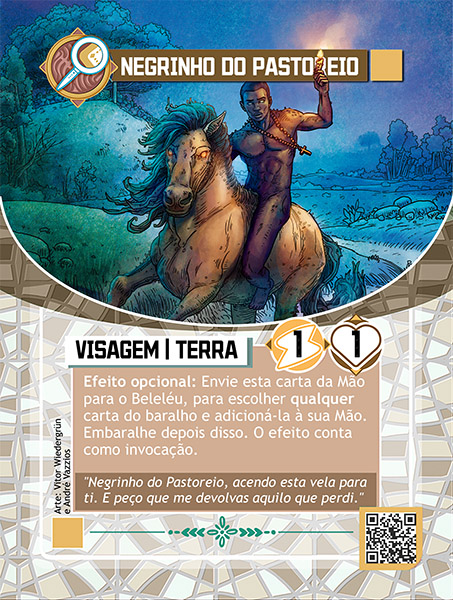
Negrinho do Pastoreio
Strength: 1
Health: 1
Wonders / Earth
“Negrinho do Pastoreio, I light this candle for you. Please bring back what I have lost.”
Votive Candle · Search
Send this card from your hand to the Beleléu (your discard pile). Search your deck for any card, add it to your hand, then shuffle. This effect counts as a summon.
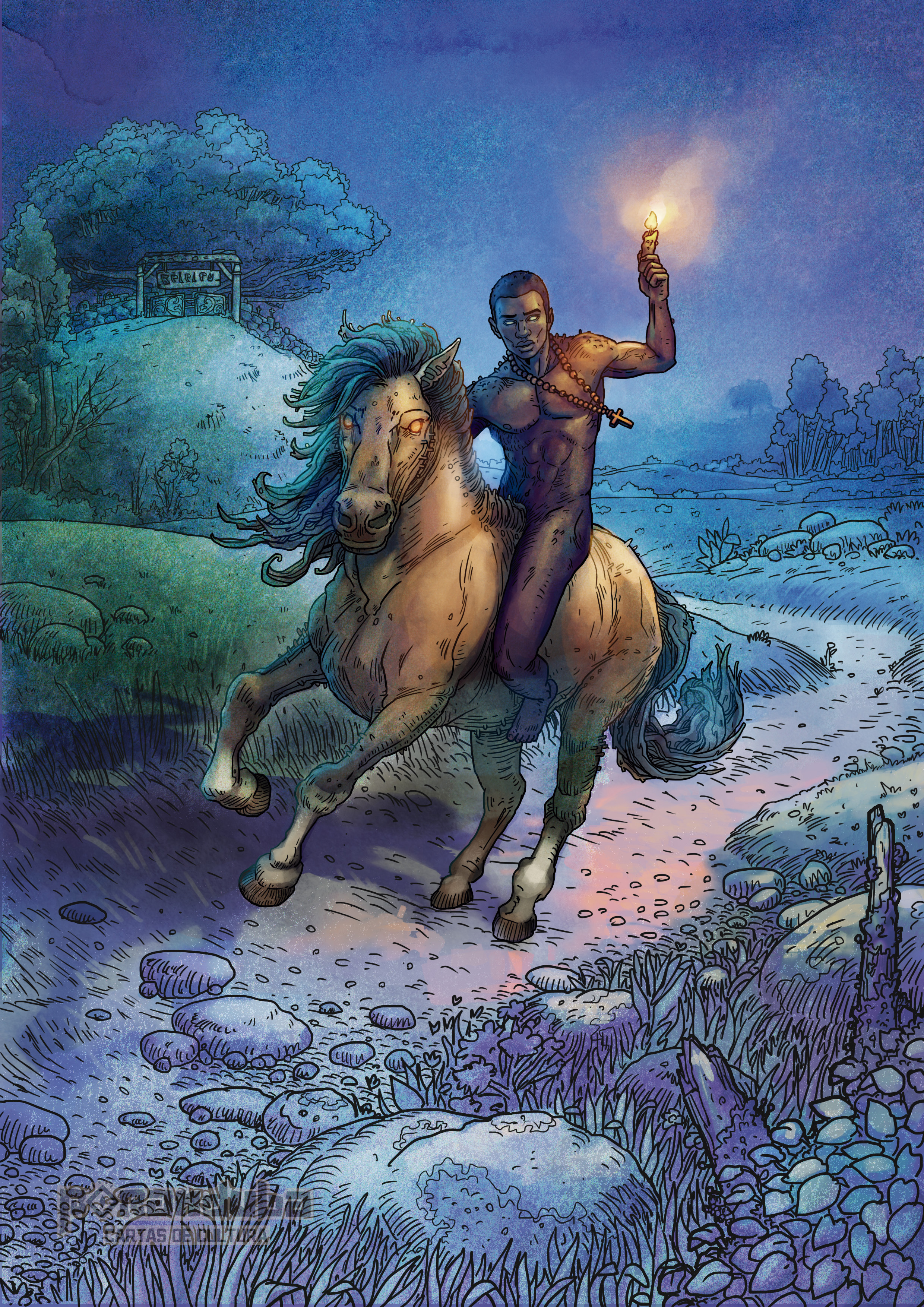
Download the high-resolution artwork
References
- CARNEIRO, Antonio Joaquim de Souza. Os mitos africanos no Brasil: Ciência do Folk-lore. São Paulo: Companhia Editora Nacional, 1937. (bdor.sibi.ufrj.br)
- CASCUDO, Luís da Câmara. Dicionário do Folclore Brasileiro. São Paulo: Global, 2012.
- CASCUDO, Luís da Câmara. Geografia dos mitos brasileiros. São Paulo: Global, 2002.
- LOPES NETO, João Simões. Contos gauchescos e lendas do sul. 3. ed. Porto Alegre: Globo, 1965.
- NEGRINHO do Pastoreio – Jayme Caetano Braun e Glênio Fagundes. Publicado pelo canal O Canal do Roos. YouTube, 6 set. 2020. Vídeo. (www.youtube.com)
- OLIVEIRA, Ellen dos Santos. Jesus Cristo no epos do Negrinho do Pastoreio: da lenda à Súplica ao negrinho do pastoreio (1959), de Fernandes Barbosa. 2021. 617 f. Tese (Doutorado em Letras) – Universidade Federal de Sergipe, São Cristóvão, 2021. (ri.ufs.br)
- SPALDING, Walter. Tradições e superstições do Brasil Sul. Ensaio folclórico. Coleção “REX” 3. Rio de Janeiro: Edição da “Organização Simões”, 1955.