

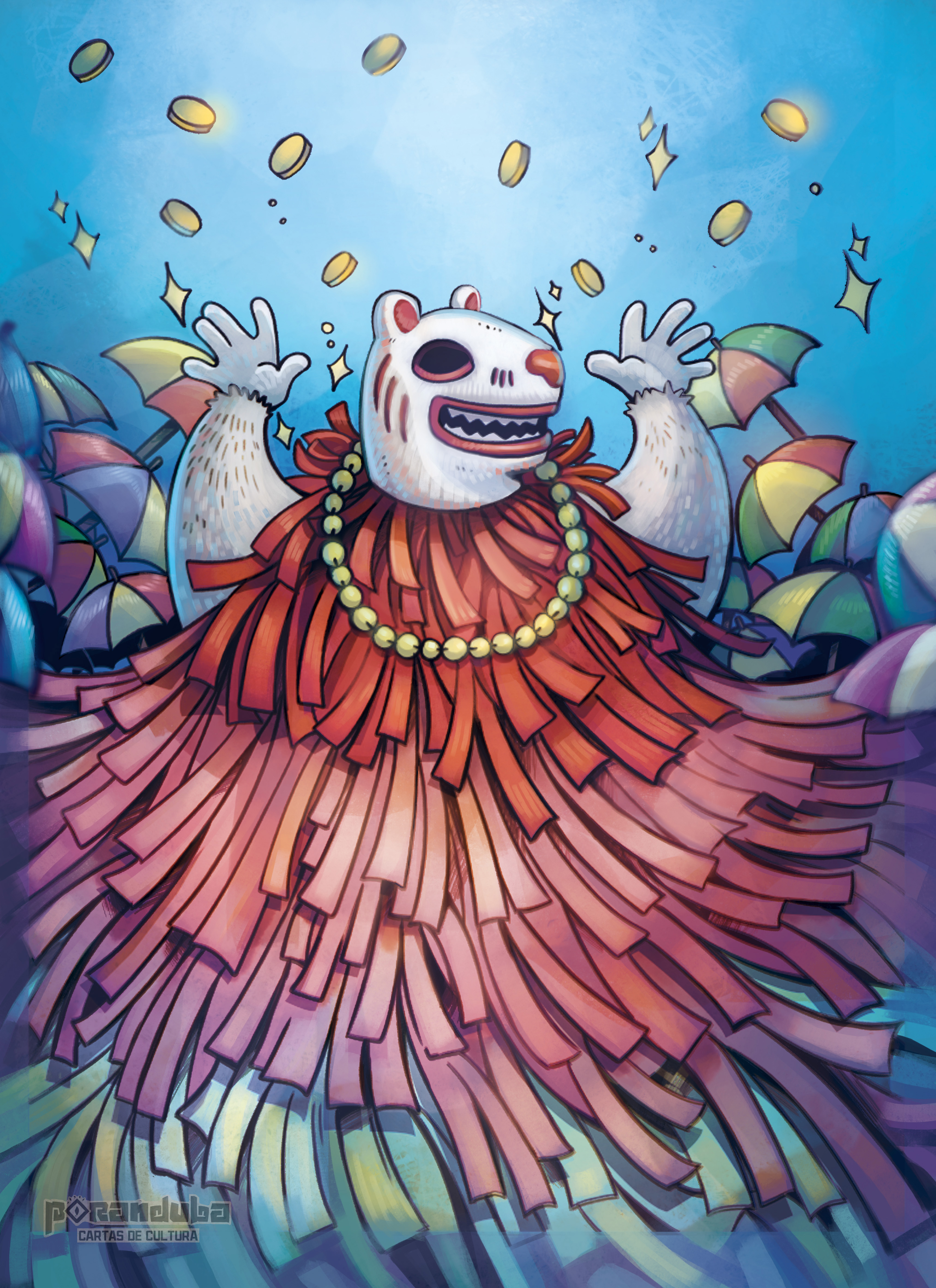
Illustration by Bruna Andrade
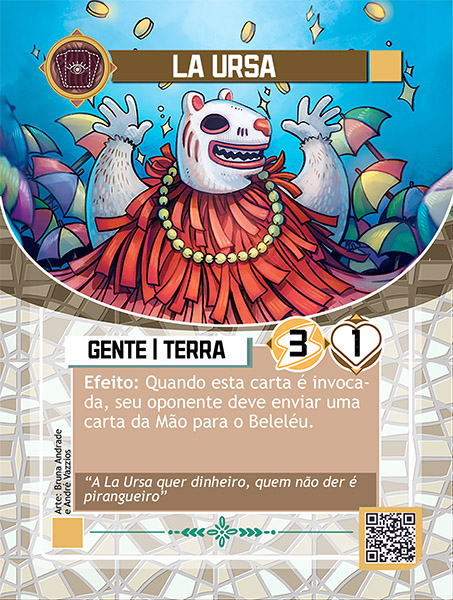
La Ursa
Folklore and history
One of the best-known masked performers of the Pernambuco carnival is the so-called “La Ursa”. In the oldest records, however, this character was only referred to in the masculine, as the “Carnival of the Bears”. It is, nothing more and nothing less, a person dressed in a large papier-mâché mask in the shape of the animal, with leather gloves, with claws on the fingertips (usually made of wire), and a jumpsuit in which small patches of fabric are sewn on, as if they were fur. In some cases, the costume is so ornate that it weighs more than 30 kg.
Dancing bears and costumed people
The tradition, they say, has roots in Eastern Europe, where, during the Middle Ages, it was common to find caravans of travelers with trained animals, to perform to the sound of violins and tambourines in exchange for money. Among the Romani, part of the people known generically as gypsies, a clan carries, even in the family name, this culture: the “Ursari”, “bear tamers”.
Later, throughout Europe, this type of entertainment could be found. Among the Italians, already in the 18th century, a group famous for its taming also emerged: the “Orsanti”. They performed with monkeys, camels, but mainly with bears – with whom they simulated fights, to the delight of the audience.
The practice persisted in various ways throughout the centuries, including in its most traditional form. Only in 2006, due to increased concern for animal welfare, was the culture of the dancing bear widely banned by the European Union. However, in non-signatory countries, there are still reports of people training bears to perform movements that simulate the dance.
Over the centuries, another way the tradition found to stay alive was the replacement of the bear-animal with a costumed person. This is what we find today in the Moldova region, also in Eastern Europe, where the dancing bear was banned during the communist regime in 1998. That is how, little by little, the Festival of Ancient Traditions and Customs emerged. In it, men and women wear bear skins, sing and dance accompanied by a tamer and a gypsy. The groups go from house to house to drive away evil spirits and bring good luck.
La Ursa in the Pernambuco carnival
We find the same structure in the Brazilian La Ursa carnival: a bear, a hunter, a tamer – only without the ritual function. What La Ursa wants, the march makes very clear, and it is not to ward off bad spirits. "La Ursa wants money, whoever doesn't give is stingy," repeat those who accompany the reveler. Pirangueiro is slang with several different meanings in the states of the Northeast, but in Pernambuco, specifically, it means stingy, miserly.
The oldest record of Urso in Pernambuco dates from 1817 and was made by a French traveler named Louis-François de Tollenare. He talks about a game in which two masked people danced, while a hunter used a piece of wood to act as a rifle and a spear. The Frenchman does not mention that they asked for money, but he says that he distributed a shot of cachaça to everyone present.
It is estimated that the first major migration of gypsies, coming from the Balkans to Brazil, took place at the end of the 19th century, bringing some exotic animals. Gilberto Freyre records that, in Pernambuco, the children of the sugar plantations encountered, alongside the gypsies, “real bears, or pretend ones – just a skin over a man – that danced to the sound of tambourines, and […] large monkeys, dressed as mistresses, full of ribbon bows, who also danced and made jokes”.
The name and continuity of the game
And where does the name of the performer “La Ursa” come from? Some people will say it comes from Italian, which is grammatically incorrect. After all, in the language, the correct word would be “orso” (bear). It so happens that, in the 1960s, it was common for the tamer to also be called “Italian,” and he was responsible for whipping the masked person, with instructions in foreign Portuguese: “Anda, la ursa! Anda, la bicha!” (Come on, bear! Come on, you beast!). A parody, then, gave rise to the grammar that only exists for the game.
Nowadays, La Ursa is officially part of the Recife city hall's carnival program. There are groups, such as carnival blocks, that compete, year after year, for cash prizes, and that fight to move up or stay in the special group, group 1, group 2, and access group. Its mask has become so iconic that it has entered pop culture.

La Ursa
Strength: 3
Health: 1
Folk / Earth
“La Ursa wants a penny! Only a skinflint won’t give any.”
Alms · Evil Eye
When you summon this card, your opponent must send a card from their hand to the Beleléu (your discard pile).
Download the high-resolution artwork
References
- FREYRE, Gilberto. Nordeste. Aspectos da Influência da Cana sobre a Vida e a Paisagem do Nordeste do Brasil. São Paulo: Global, 2013.
- PEREIRA DA COSTA, Francisco Augusto. Folclore Pernambucano. Rio de Janeiro: Imprensa Nacional, 1908.
- REAL, Katarina. O folclore no carnaval do Recife. Rio de Janeiro: Ministério da Educação e Cultura (Campanha de Defesa do Folclore Brasileiro), 1967.
- TEIXEIRA, Rodrigo Corrêa. História dos ciganos no Brasil. Recife: Núcleo de Estudos Ciganos, 2008.
- TILDEN, Imogen. Romania's new year bear dancers – Alecsandra Raluca Dragoi's best photograph. The Guardian. 8 jan. 2020.
- TOLLENARE, L. F. Notas dominicaes: tomadas durante uma residencia em Portugal e no Brasil nos annos de 1816, 1817, 1818. Recife: Empresa do Jornal do Recife, 1905.