
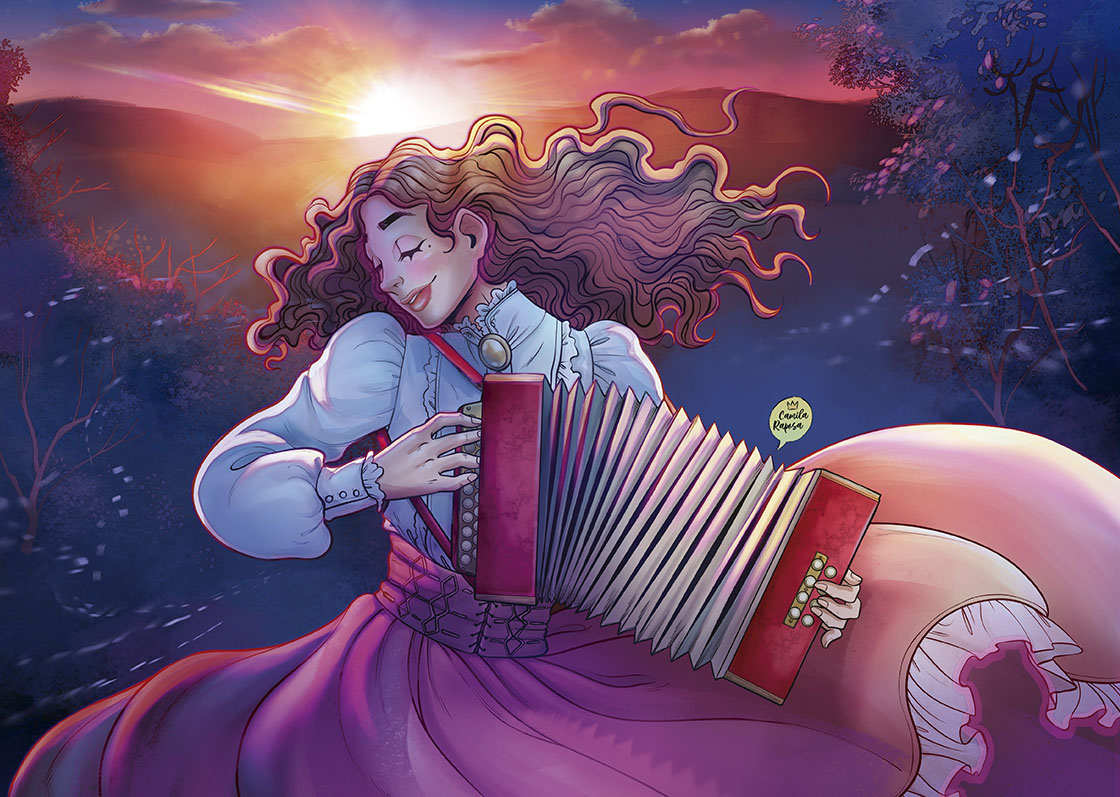
Illustration by Camila Raposa and André Vazzios
Accordion Player
Folklore and history
I want an eight-bass accordion to see the sound it makes Boots made in Alegrete, spurs from Ibirocai Red scarf and money belt bought in Uruguay So that when I pass by they say, He came out just like his father – Guri (1983), by César Passarinho
The names of the instrument
Accordion, concertina, harmonica. These are names for the keyboard or button instrument, composed of two boxes connected by a bellows. In Rio Grande do Sul, it is known as gaita. In the entry “Gaita”, from the Dictionary of Brazilian Folklore, Cascudo associates the name with the bagpipe: both instruments have bellows (2000, p. 257, apud Gomes, 2023, p. 260). Sanfona is the most common name in the Northeast, although, in Portugal, the word also designates a stringed instrument.
The name “accordion” comes from German, referring to musical chords. Here, it is also common for the player to call it “cordeona,” which is a feminine way of referring to the instrument that spends the nights wrapped in the musician's arms.
The place of women in music
This last detail leads us to the centrality of the text on the figure of the accordion player: the place of women in traditional Gaucho music. In general, it was not strange for a woman to know how to play the accordion, but for a long time, this was a space that was subordinated to her, not that of a protagonist. Women were inspirations, muses.
In 1956, for example, the Bertussi Brothers recorded “O Casamento da Doralícia,” considered the first phonographic recording of the bugio, a typical rhythm of the pampas. In an interview with Fernando Henrique Machado Ávila on July 13, 2014, Adelar recounted that one of her inspirations was a bagpiper known as Losa do Benjamim, from the Mulada region. She played for her brothers when her father went out, as she feared being beaten if he heard her. After all, the bugio was associated with prostitution and considered inappropriate for a woman to play (Ávila, 2015, pp. 31–32).
Mary Terezinha and Jeanette
Two of the pioneers in the music industry were Jeanette Ferreira da Costa (1942-2017) and Mary Terezinha (1948–2025). The latter, who played from a young age, charmed audiences as a child by knowing Victor Matheus Teixeira's repertoire by heart – to the point of becoming known as "Teixeirinha in Skirts," according to herself. At the age of 15, after winning a contest, she was invited to accompany the accordion player. From then on, her life would change forever.
The duo Teixeirinha and Mary Terezinha were very successful between the 1960s and 1980s. However, as she herself recounts in her 1992 autobiography, the relationship was marked by all kinds of abuse and violence against the young woman – who was 23 years younger than the singer. The first paragraph of the book already demonstrates this: “I am fifteen years old and I am living as the concubine of a man I do not love, although I do not know what it is to love or what it is to be a lover. The man’s name is Victor Matheus Teixeira, better known as Teixeirinha. He used to be my idol.”
Faced with the threats and sexism of the time, Mary managed to break off the relationship and continue her career. She died in 2025. Her story inspires other women to find the strength to get out of abusive situations, which are unfortunately so common.
Jeanette was born in Cruz Alta, Rio Grande do Sul, and learned to play as a child, with her mother, who played seven instruments. At the age of 14, she began to accompany the traditionalist musician Gildo de Freitas – the King of Trova.
In the 1960s, while working as a radio broadcaster, she met Nelson, with whom she formed a duo for more than 20 years, producing 22 albums. Jeanette became known as the Queen of the Accordion, such was her recognition. The duo Nelson and Jeanette ended with the end of their relationship and, unfortunately, their success was never the same again.
Changes in tradition
Today, the role of women in society – and, consequently, in traditional music – has changed.
We already have women who are patrons of CTGs, the Gaucho Tradition Centers. Movements like Liquid Gauchoism, by researcher and composer Clarissa Ferreira, are emerging, which problematizes the core of the tradition. We have the case of Gabriella Meindrad, the first trans woman to become a "prenda" (a traditional female figure in Gaucho culture) in a CTG. And, on the other hand, we also have women who go on stage already wearing boots and bombachas (traditional gaucho trousers), no longer in dresses. For a long time, it was necessary to be dressed as a "prenda" to reach this very masculine space. A tradition established by the Traditionalist Movement itself, which created the garment in the mid-20th century.

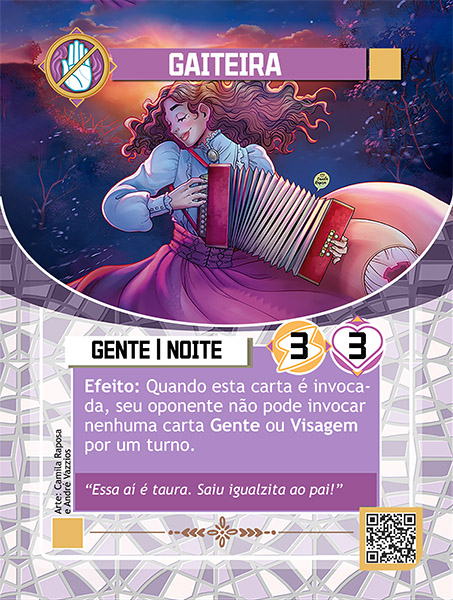
Accordion Player
Strength: 3
Health: 3
Folk / Night
“That one’s got grit. The very image of her father!”
Singer of the Southern Plains · Pause
When you summon this card, your opponent cannot summon Folk or Wonder cards for one turn.
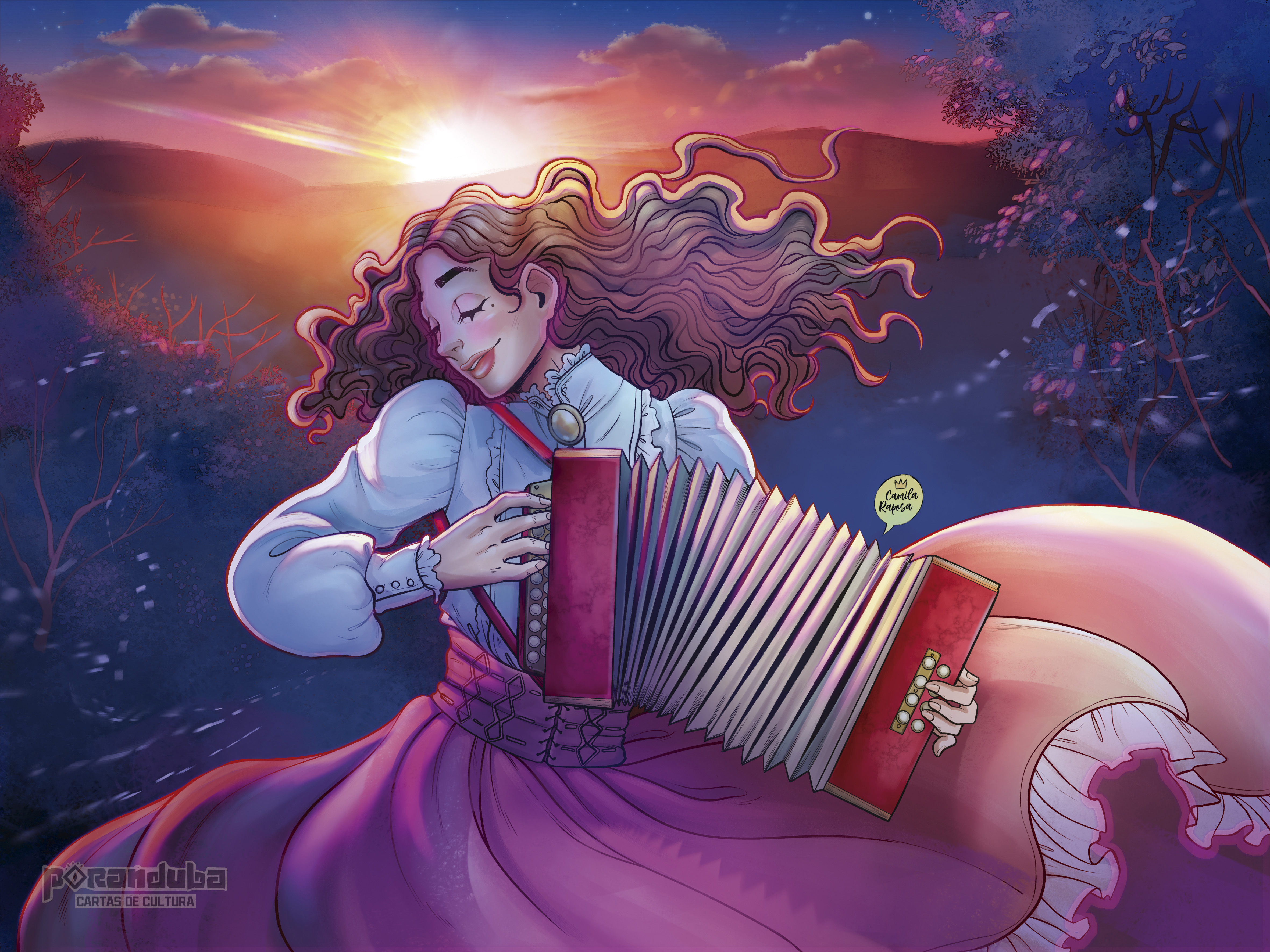
Download the high-resolution artwork
References
- ÁVILA, Fernando Henrique Machado. Os Irmãos Bertussi e a música regional de baile no Rio Grande do Sul. 2015. Trabalho de Conclusão de Curso (Bacharelado em Música Popular) – Instituto de Artes, Universidade Federal do Rio Grande do Sul, Porto Alegre, 2015. p. 31–32. (www.bibliotecadigital.ufrgs.br)
- GOMES, Marianna de Franco. A ergotoponímia mineira e seus campos lexicais. 2023. Tese (Doutorado em Estudos Linguísticos) – Faculdade de Letras, Universidade Federal de Minas Gerais, Belo Horizonte, 2023. p. 260. (repositorio.ufmg.br)
- REOLON, Cleici; OLIVEIRA, Natalie. A moda do vestido de prenda: do surgimento até os dias atuais. RIHRGS, n. 157, Porto Alegre, 2019. p. 175–196. (seer.ufrgs.br)
- SÃO GABRIEL (RS). Prefeitura Municipal. Tributo a Mary Terezinha celebra legado da “Menina da Gaita” em São Gabriel. São Gabriel, 8 jun. 2026. (www.saogabriel.rs.gov.br)
- TEREZINHA, Mary. A Gaita Nua. Porto Alegre: Rigel, 1992.